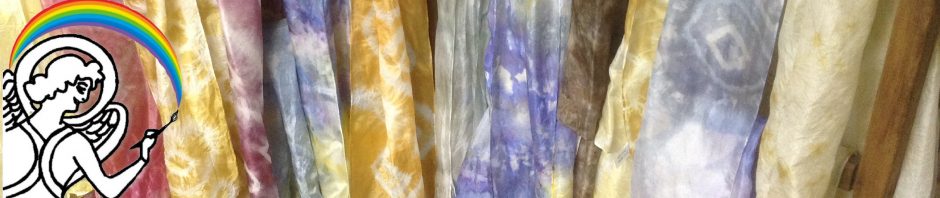
 I have been doing a lot of experiments natural dyeing , and I decided to take a course, to get the knowledge in place systematically. So I’m doing a three module course with Justine Aldersey-Williams this year.
In module 1, on colour, we have been learning to make a rainbow out of three plant colours. Justine selected three of the oldest dyestuffs, as they stand the test of time: indigo for blue, weld for yellow, and madder for red.
My weld and indigo both worked well. As I was focussing on small samples, which takes a lot of faffing, I didn’t want to have a lot of due left to use up at the end of the session. I think I have been a bit stingy with the madder. The red is a bit pale.
I did three primary colours and overdyed with the same set of dye baths to get three secondary colours. Then I used modifiers to get a bigger range. I used white vinegar, washing soda, and an iron solution. One red changed so much that I thought it was orange. The weld seems to have dominated the reaction, as all the colours with any weld (yellow, orange and green) look practically the same.
The whole process took quite a lot of time. Normally, I would not have needed to record everything, and keep all the samples in the correct order. As a result, I left everything top dry in a foil tray. And managed to dry creases in. I knew perfectly well that was going to happen, but by the time I got that far I was too tired to think straight.
For the course, I had to show dyed samples in my dye journal, and also prepare a sample card. I’ve also done a small wall hanging to use a nail in the wall of the sewing room (left over from its previous use in my ex’s office). I have another set of samples, which I plan to turn into bunting, but I haven’t got that far yet…


 Remember Spirograph? You put the point of a coloured pen into a hole in a plastic wheel, then rolled that wheel round the inside of a plastic ring to make a pattern. The two bits of plastic were held together by cogs.


 I’ve decided to buy a toaster oven to use in the dye house (OK, it is a garage really). I like to work out there so that chemical things stay out of the kitchen, but also to keep the house smell free. I have been using slow cookers, but they don’t allow control of the temperature, only the time. If you want to use things like madder, control is key.
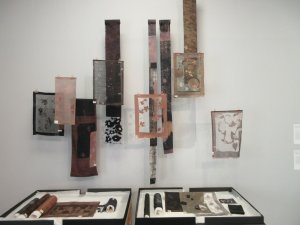 Here are some pictures of Hannah Lamb’s experiments based on katagami, Japanese dyeing stencils. The pictures were taken at the National Centre for Craft and Design in Sleaford, Lincolnshire.


 The Pump Room in Harrogate is always worth a visit, although I have never managed to sample the “health giving” waters. The smell is too much for me.


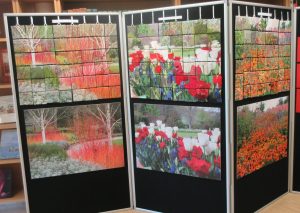 Members of the Richmond and Leyburn branch of the Embroiderers’ Guild are working on a project together. They are selecting typical pictures of Harlow Carr gardens, known as the Wisley of the north, near Harrogate, dividing them into squares, and embroidering one each. The first three panels are on display in the


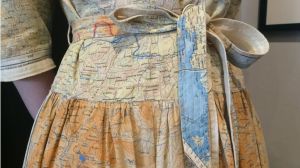 Now I know I’m a bit slow, but I’ve only just found this on Twitter. A silk map designed to help prisoners of war to escape, made into a dress.
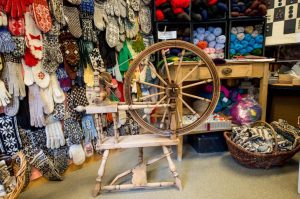 Here is a fascinating article about the Sweater Detective, a lady who knows practically all there is to know about the myths and meaning woven into
  Another collection of pictures from the National Centre for Craft and Design in Sleaford, Lincolnshire.



 The Rainbow Angel