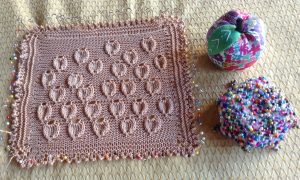
Some basic embroidery stitches

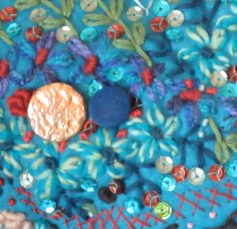
I’ve come upon this quick guide to basic embroidery stitches, which I thought would be worth sharing. As the author says, it is amazing how much you can achieve with a few basic stitches.

Although I am surprised they have missed out herringbone stitch, which is one of my favourites. And how do people manage without feather stitch and all its variations?

But I am getting carried away. We are talking basic stitches here.

Posted in Techniques | Tagged , , | Leave a comment

Weaving a willow deer

At the back of my mill, there is a meadow. For a while, there was a scheme to have a summer house down at the end of the meadow. I was thinking about making some sculptures out of chicken wire, so there could be fairies at the bottom of the garden.

Realistically, the prospect of sitting on the terrace, near the house and looking at the meadow is a great deal more enticing than getting organised to carry everything down to the other end. I don’t like to be too far away from the next cup of tea.

So I need another idea.

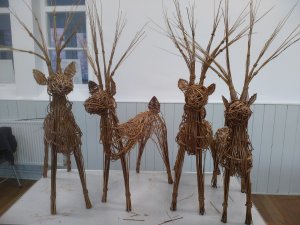
Over Christmas, I was looking on Instagram and found some fabulous willow sculpture. I thought that might be a good plan, so I did some research, and ended up in a workshop in Sherburn in Elmet with Leilah Vyner of Dragon Willow. We made the four at the top of this post. Horace is on the right.

We began by making a series of rings. Then we each had a wooden jig, with holes about an inch in diameter, which we stuffed with willow. After making a framework by linking single bits of willow with an overhand knot, we fixed rings on at strategic points to make the basic shape. All of which seemed a bit flimsy and unpromising. Some of the strands of willow from the back of the animal were curved round to refine the shape, then all the spare bits were woven in randomly. More willow was added to shape the front. That took all morning.

After lunch, we stitched the smaller rings together into a head shape with willow, and wove into this base. Leilah made it look easy, and our basic shapes looked nothing like as good as her’s. She told us to keep weaving in some more willow, keeping an eye on the shape as we worked, and she was right. Suddenly we all had something that actually looked like a deer’s head.  A bit of flat weaving to make ears and tails, a few knots, and a bit more random weaving to fill in any gaps, and we were done.

All of which makes it sound much more straight forward than it was, but that is the bare bones of the process. You can see my work in progress below, culminating in Horace looking out of the window at home. He isn’t allowed out yet, as he hasn’t had his injections. He needs a coat of boiled linseed oil and turpentine, and before he has that, he has to dry out properly. Which reminds me, the willow only bends properly when it is wet, so the different colours you see in the pictures are from the willow drying out.

And here is the gallery of everyone else’s work:

Posted in Techniques | Tagged , | Leave a comment

Twenty uses for a bulldog clip

I must say that I think the title of this post is rather pushing it.

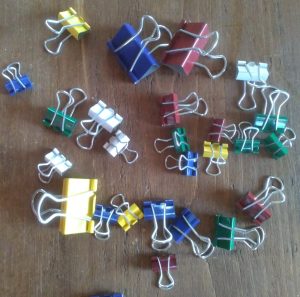
Some of these “ideas” are only what I thought a bulldog clip was for.

But on the other hand, there has got to be some mileage in the brush holder idea.

And I rather fancy the jam jar lid palette.

I shan’t be trying the idea for hanging the end of a bottle from a nail. With my luck, I would put in just a bit too much weight, and the whole thing would ping off the wall.

Posted in Equipment | Tagged , , | Leave a comment

Pattern weights

Sometimes, pins just won’t do.

img_20180910_151445101815622.jpg

You might be using something where the pins would leave holes. Like leather, pvc, or paper.

You might not want the distortion you get when you lift everything up to get the pin through.

You might not want the bother of putting the pins into the pattern just to take them all out again a few minutes later.

Then the answer is to use pattern weights. Chunky pebbles do the trick, if you can find ones flat enough. Tins hold the pattern down, but sometimes cutting round them is difficult. The height gets in the way. A set of weights from kitchen scales can be useful, but of course their sizes vary, so you might find that you have used the crucial one already.

So the answer is a set of proper pattern weights, with flat bottoms, in a sensible size for the job. For a while, I have been getting round to making myself some fabric weights. I have seen lots of pictures on line. Equilateral triangles, cut from pretty scraps, stuffed with rice will do the job. A 2″ base triangle seemed like a sensible size.

Eventually I got round to making a trial one. The size seems about right, and the tetrahedron shape means it is easy to pick up. But it seems a bit on the light side.

But now I’ve found some really pretty ones on Etsy. The only difficulty is deciding which diameter to get. I suspect this would still be a difficult decision if you were standing in a real shop and could see and feel them. This is the sort of knowledge that comes with experience. I went for the middle sized ones, partly because the middle size is often the most flexible. But also because a set of 6 gives you a decent number, with no duplicated pictures.

img_20180910_1516432116181281.jpg

My collection at the moment

And how to do they compare weight wise? The bought ones weigh 47g. The home made one weighs 24g. Well that will be why mine feels light then. My guess is that I need to use 2.5″ triangles to get a comparable weight. Having tried these weights out, I’m not bothering to make any more. Cutting out my new dress was much quicker than using pins, and the weights stayed put nicely.

Posted in Equipment | Tagged | Leave a comment

Peacock fire screen update

Over Christmas, I’ve been working on my fire screen project again, so this post is an update following on from the post I published in September.

Obviously, a crucial part of the whole thing is the method of attaching the feathers to the bird. Originally, I was thinking that it needed to be quite sturdy, so I was thinking of asking somebody competent to cut a suitable piece of wood, and drill holes to hold the pieces of dowel that forms the middle of the feather. But that idea works best when the feathers are a nice even shape, with identical width.

Which they aren’t.

So I thought I would see what I can do with fabric. I made two piramid shapes out of felt, to support the back of the bird, and stop it from moving from side to side. The outer side is embroidered, of course, to blend in. Then I cut two semi-circles of calico, and sewed channels in them, to take the dowels. That looked promising, so I attached it to the piramids. Then I cut a felt cover for the dowel holding calico, partly to make it blend in, and partly so that I can sew the lower end of the feathers to the holder, as I cut it larger. The front of this felt cover needed decoration, but I wasn’t sure how much would be visible, and I didn’t want it to get in the way of the structural stitching, which will come later. So I’ve just done some random machine embroidery.

These pictures show the feathers, slotted into the holder, cut to size. As they are not yet sewn in, they are laid out on the living room floor, with the bird slotted in to check the effect. I’m hoping that the fact the bird stayed balanced there for some time without further support is a good omen!

I’m now thinking of making some smaller feathers, with just the upper half visible, to full in the gaps. And I’m also thinking of fixing a horizontal dowel (or two) at the back, to stop the feathers spreading sideways, or twirling in their sockets.

And the prospect of sewing the feathers into the base, and the base onto the bird isn’t particularly appealing. Still, where there’s a will, there’s a way.

But it may take some time…

Posted in Textiles | Tagged , , , | Leave a comment

Happy New Year!

Sarah C Swett’s post headed “You Can’t Always Get What You Want” has some wise words for the New Year.

And, as usual, some quirky ideas about textile related matters!

One day, I will try some of these ideas…

Posted in Techniques | Tagged | Leave a comment

Knitting videos

Here is a collection of knitting videos, including some interesting ways to knit with colours.

The last time I looked, they were up to episode 66, so there is plenty to get your teeth into there!

Posted in Techniques | Tagged , , , | Leave a comment

Knitting faces in the crowd

It is surprising how inspiration comes.

I was rummaging in a basket of odd balls of yarn, as you do, and I found this “flesh” coloured smooth cotton.

Which reminded me of my long standing doll project, where I have some knitted dolls, and use them as models for unusual garments. This is a wonderful game, as it allows me to:

  • Play at being a doll designer.
  • Experiment to see how patterns and shapes work. It is amazing how many designs look fab in the pictures, but a mock up reveals that it only looks nice if you are careful how you stand and move about. It is also surprising how many patterns for really chunky yarn knit up nicely for a doll if you use 4 ply and the smallest needles you can manage,
  • Play with novelty yarns that need buying, but I’m not going to wear in a full size garment.

Anyway, I wasn’t convinced there was enough of this cotton to make a whole doll, so I put it down again. And then I thought of making pictures.

I have seen some interesting paintings of crowd scenes, with a variety of faces looking out of the frame. And I loved the Antony Gormley check installation Field for the British Isles when it came to Scunthorpe. Although ideas have been lurking for a while, I haven’t actually got round to doing anything.

So I experimented.

The first idea was to knit some bobbles on a reverse stocking stitch ground. Bigger ones were too round, and smaller ones didn’t give enough space for embroidery to make a face.

So then I tried increasing for a bobble in one stitch, and then working a few rows all across the piece before decreasing. I decided not to plan a design, because that would lead to some annoying endless dithering, so I just went for it and made it up as I went along. After blocking it out, I embroidered faces, hair and hats. One end of the head was a bit too open, so I made that the top of the head, stitched it up a bit, and covered it with hair and hats. I decided not to go for faces on this one. That is on the list for future experiments.

This one is now for sale on Etsy.

Posted in Techniques | Tagged , , , | Leave a comment

My new quilting toy

I have a new toy.

I saw various versions of the idea at the Festival of Quilts in August, but when I went to knitting and stitching in Harrogate I decided to go for it.

Basically, instead of bothering to mark out the pattern on the fabric before you start quilting, you use a stencil type piece of plastic. There are various systems available. Mine is like a tram track. You drop the feed dog, put the presser foot in the channel, and the foot is guided down your chosen path.

I’ve got basic templates: a straight line with inches and angles marked, a set of circles, and a feather.

Now this was a bit of a risk, because I’ve never been very good at free motion quilting.

But I can do it now.

And yes, I know some of them are a bit wobbly, but I’m happy with my first attempt, especially as I was trying it out on black print, which isn’t the easiest thing to see when you are stitching. The next thing I’m going to do is a flower, which I saw demonstrated with the circle template, but you need to aim for the centre, so I’ll need a paler fabric.

And in case you are wondering why I didn’t do my samples on plainer, paler fabric, it was because I needed to quilt the pieces for a bag I’m making. And as I expected, the quilted patterns don’t show up much, but that isn’t the point. I have had useful practise, and the quilting makes the fabric firmer.

Posted in Techniques | Tagged , , | Leave a comment

Stitch resist

I’ve never been much into craft classes. Books and the internet are my normal sources of training, because they are available when I want to know something. Which is usually so that I can start something NOW.

But every now and then, something catches my eye. I had seen that the University of Leeds had an exhibition called Resists: exploring resist-dyed textiles across cultures, which runs until 13th December 2018, and I was toying with the idea of going. But I was busy with work, and it is a long way to go. Then I saw they were running a stitch resist workshop afternoon, so combining the two seemed like a good bet.
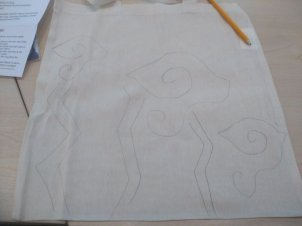
Bintan Titisari gave us some background to this traditional Indonesian techniques, showing us the range of effects that are created on various different islands, and some of the traditional motifs. We were then let loose with cotton bags and a pencil to create our own designs. Mine combines two traditional motifs, with the general plan of representing a storm, with rain coming from the cloud motifs, a blue background, and rainbow colours appearing at random.

Once our designs were complete, we sewed along the lines with running stitch, gathered up the stitching, and tied the thread in very firm knots. This technique is a form of tie dying, where the dye can’t get at all the fabric because of the bulk of the fabric round the gathers. I intended to take a picture at this stage, but we were running out of time, so I forgot. Bother.
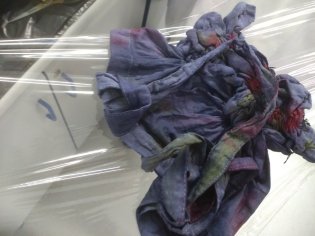
The next stage was to move into a lab to apply the colour. It felt very strange to be decked out in lab coats, goggles, and gloves to mix and apply Dylon, which is safe to use in your kitchen at home. We had dye in primary colours, and after soaking our bags in a background colour for 15 minutes, we moved on to carefully squirting other colours in selected places using plastic ketchup bottles, which seems rather incongruous in a lab. We could then choose whether we went for the technical option of leaving our bags to be “cooked” at 40°C for 24 hours in the University’s special colour setting oven, or taking it home and leaving it wrapped in cling film for 24 hours. I went for the latter option, to avoid going back to collect the bag. The picture shows my dyed bag being properly wrapped by two experienced textile specialists.

Once the parcel had matured for 24 hours (OK a bit longer, while I got round to it), I rinsed the bag in cold water and left it to dry, before undoing the knots and releasing the stitches. At this stage, the cotton is crinkled where the stitches used to be. It is possible to stitch both sides of the bag separately, but as you can see, to save time, I sewed through both layers at once. The two sides are slightly different, due to different amounts of extra colour being applied.

To remove some of the creases, I soaked it in water again, dried and ironed it.

I’m pleased with the result, but it is interesting to see that you can see the places where I was rushing because I was running out of time.

I always think it is interesting to reflect on what I’ve actually learned on any training course. Sometimes it isn’t what it I expected it to be. The most useful things from this course were:

  • I was reminded of a method of making a knot at the end of your thread. Hold the end of the thread on your needle with your thumb, wrap the thread round the needle 4 or 5 times, and pull the needle through the loops. How could I have forgotten that?
  • I was introduced to cotton darners. This type of needle was easy to thread, and good for any technique where you are making long lines of stitches, or large straight stitches. They are easily available in good old Samuel Taylors in Leeds, but I didn’t have time to go back there on the way to the train. I’ve had blank looks in several shops, but have now found a pack.
  • When I’ve tried this technique on my own, I have used a strong polyester thread. The thread we used was slightly rough, which helps to hold the fabric in place. This photo is not the best, but it serves as a quick reminder of the “new” needles and thread.
Posted in Techniques | Tagged , | Leave a comment