Clive

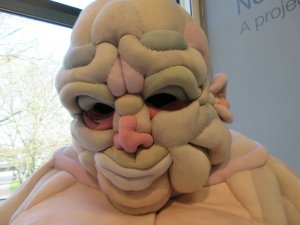
This is Clive. I saw him on display at the National Centre for Craft and Design in Sleaford, Lincolnshire. He was made from of viscose, polyester wadding, plastic pellets and cotton by Daisy Collingridge.

Isn’t it amazing how much detail she has achieved?

I think the eyes are the cleverest part. They have such depth.

Posted in Textiles | Tagged , | Leave a comment

The EYES Rainbow banner

Here is another group project from the East Yorkshire Embroidery Society’s exhibition Hopes and Dreams in Stitch, which is at Beverley Minster from 10am to 4pm every day until 10th May.

Participants were given a square of fabric, and asked to create a small panel in any technique. The results were then strung together into this rainbow panel. Get there quickly, it closes tomorrow:

Posted in Techniques | Tagged , | Leave a comment

Flowers at the EYES exhibition in Beverley

More from the East Yorkshire Embroidery Society’s 2019 exhibition Hopes and Dreams in Stitch, which is at Beverley Minster from 10am to 4pm every day until 10th May. Today a collection of pictures showing some of the ways landscapes can be interpreted:

Posted in Textiles | Tagged , | Leave a comment

Follow the Thread exhibition in Glasgow

If you are in Glasgow before 27th May 2019, this exhibition from the Glasgow University Archives looks good. They have illustrations of Victorian evening gowns, swatches of Edwardian fabrics, and catalogues full of designs fit for a 1920s flapper girl and photographs of mini-skirted models from the swinging 1960s.

The university has an important collection, including the annals of more than 130 Scottish textile businesses such as thread mills, dye works and dress shops: companies which designed, manufactured and traded the fabrics that for 200 years, clothed a substantial part of the world’s population.

And it is on at The Lighthouse, a Charles Rennie Mackintosh building that is always worth a visit when you are in the middle of Glasgow.

Posted in Textiles | Tagged , | Leave a comment

Pot of gold

Here is part 3 of my series of posts from the East Yorkshire Embroidery Society’s 2019 exhibition, Hopes and Dreams in Stitch, which is at Beverley Minster from 10am to 4pm every day until 10th May.

Today’s pictures show the results of the chairman’s challenge, to produce a 3D item on the theme of My pot of gold.

Notice the tea cosy with a rainbow above it.

And the “used” paint brush balanced on the open tin:

Posted in Textiles | Tagged , | Leave a comment

A view of Beverley

This textile view of Beverley is the result of a group project by members of the East Yorkshire Embroidery Society.

It is on exhibition as part of Hopes and Dreams in Stitch, which is at Beverley Minster from 10am to 4pm every day until 10th May.

Following a suggestion by Anne Pye, they selected this picture, divided it up, into vertical sections, agreed on the finished size, and made a section each, using whatever techniques they wanted.

You can see the original picture and the list of the artists involved here.

This slide show gives a closer view of each group of three panels:

This slideshow requires JavaScript.

This slide show shows close up of each panel.

This slideshow requires JavaScript.


Posted in Textiles | Tagged , | Leave a comment

The East Yorkshire Embroidery Society’s 2019 exhibition

Yesterday, I dropped in to see the East Yorkshire Embroidery Society’s (EYES) 2019 exhibition Hopes and Dreams in Stitch, which is at Beverley Minster from 10am to 4pm every day until 10th May.

They have all manner of things on display, and I’ll be sharing some over the next few days.

Do go if you get the chance. They would love to see you. Admission is free, and the Minster is always worth a visit anyway.

Posted in Textiles | Tagged , | Leave a comment

Knitting a plant

Recently I’ve been sorting through some experiments from my City and Guilds course. We had to find pictures, use them to inspire our knitting, and produce a sample to go in our A4 files. I knitted a mangrove swamp.  Unfortunately, it is now too squashed to take a decent photo. Perhaps one day I will restore it.

Then I also remembered the way my Mum used to do Jacobean embroidery. She would make a basic tree outline from chain or stem stitch in a variety of colours. Then the leaves and flowers would then be added, using a range of shapes that were filled in with various crewel work stitches.

So I thought I would try to combine the two ideas and knit a plant with knitted stems and leaves, and then embroider flowers. I reckoned that starting at the top would allow for not knowing how the tension worked out for width and length. I started leaves etc in random places, and after knitting down for a while I decided that I had a basic design, so I started moving the stems toward the centre of the piece.

Once the knitting was done, I embroidered flowers in french knots, bullion knots, lazy daisy stitch, and straight stitches. Here is the result:
Posted in Techniques | Tagged , | Leave a comment

Improving on the scrunch dyeing by-products

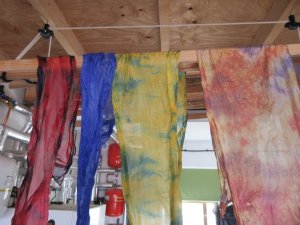
When I did some multicolour scrunch dyeing recently, I used the leftover dye to create plain scarves to use as a basis for something else.

The yellow and red scarves were surprisingly bright, considering the subtle results obtained when the colours were combined, so I decided to put them in the indigo vat. Before I did, I used the Japanese arashi shibori technique, which involves wrapping damp fabric round a pipe (or in my case an empty plastic bottle). The fabric is held in place with rubber bands, and then pushed together so that only part of the fabric is exposed to the dye. You can see the indigo vat in the background of the picture where the fabric has been scrunched up.

You can see the results below. I am much happier with these scarves now. The original colour was much too brash, but these are more interesting.

Posted in Techniques | Tagged | Leave a comment

Three colour scrunching

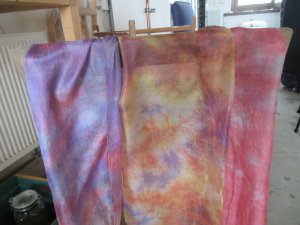
As you may have noticed, I like random mixtures of colour. One technique for achieving this is to scrunch up the fabric and pour on one dye, then repeat with more fabric and another colour, then again using a third, finally squashing it all down and adding a little extra liquid.

Most people writing about this technique are expecting to use the results to make a patchwork quilt, so they use a bucket. A silk scarf is considerably less bulky than a fat quarter, so I used a kilner jar.

I mixed more dye than I needed, so I used the leftovers to dye one scarf in each of the base colours. I think it is really interesting that the combined colours are so much more subtle than the separate dyes. It is also noticeable that the final scarf in the jar, the red one, is not as interesting as the other two mixed one. Whereas the others have a mixture of colours all over the scarf, the last one is basically red, with a couple of spots of blue, and some mottled white areas. Which will make a lovely base for something else…


Posted in Techniques | Tagged | Leave a comment