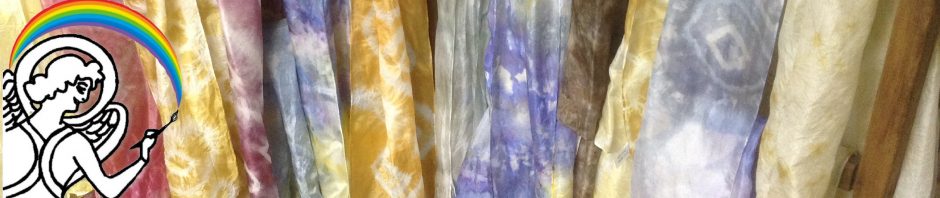
Well, everyone says that the problem with natural dyes is that you cannot repeat colours exactly. With any dyeing process, there is scope for variation due to slight differences in quantities, moisture content etc.
With natural dye stuff there will also be variations in the amount of dye chemicals in the plant because of growing conditions, time of year, and things like that.
 I know I said I was going to forget about my solar dyeing for a few weeks, but I glanced in that direction when I was passing, and noticed one of the jars was pink.
How can that be then? I have 4 jars containing flowers that were picked and processed at the same time in the same way.
The plants are a single variety, bought from a respectable supplier as plugs. They were nurtured in the kitchen, and greenhouse before being planted out.
Since the danger of frosts passed, they have been living side by side in the same beds with the same soil conditions and climate. Since I assembled them, the jars have been sitting side by side in the same place.
It will be interesting to see how this one progresses. Will it stay pink? Will the others catch up? Will the silk be anything like this colour when it is eventually washed out and dried?
I wonder if the pink jar has slightly more flowers, which has just pushed it over some boundary?
One thing is for sure. It is clearly dangerous to have fixed plans for the next stage of these scarves.

Left to right: The pink marigold jar, then one of the others which is golden, as I expected it to be.
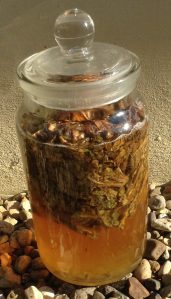 As the leaves were dry, I put about double the weight of the scarf I was using into the jar, and topped it up with cold water. I left it in a sunny place, on gravel in case of spillages, & went away for a couple of days. People I told about my experiment it to said “You’ll be lucky in this weather.”


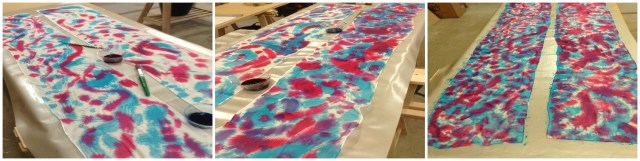 Although this technique would work on a nice, plain white scarf, that wasn’t a very appealing idea. After preparing the fabric with a mordant, I splodged two colours of dye over the scarves, allowing them to mix where the colours touched to form shades of purple. I used a different brush for each dye, so that the colours didn’t merge too much, and there was a variety of marks.
 After leaving the scarves to dry overnight, I mixed up some flour and water paste for the really messy part. I spread the paste on with a spatula, and made patterns using a chunky plastic comb. I worked in stages, because it is easier to mix the paste using about 125g of flour in each batch.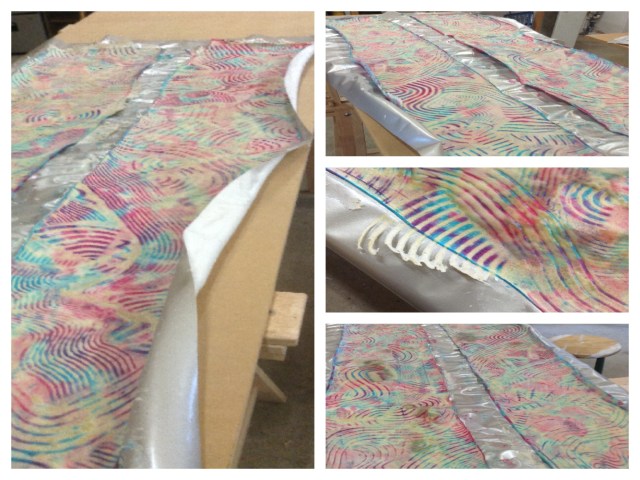
 The next stage is to mix up some dye in a different colour, and paint it all over the paste. The dye takes in the pattern drawn in the paste, and in the cracks formed in the paste as it dried.
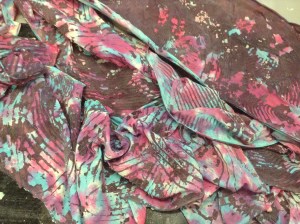 The dried paste is removed from the fabric by flaking it off. I was surprised quite how messy this was.
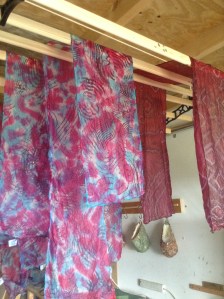 The final stage of most dyeing processes is to give it all a good rinse, and hang it up to dry.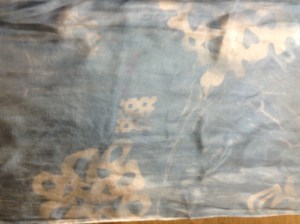
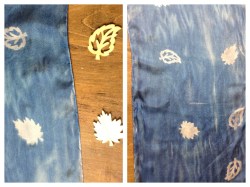 The simpler shapes of leaves worked best. Unfortunately, on this piece of fabric I had not covered the whole of the fabric, and you could see the gaps between the brush strokes.
 Either the shape is too intricate, or the angle of the light was wrong. I did these experiments in winter, so I used a UV bulb in a lamp. Some of the shapes are unrecognisable fuzzy blobs, but some are quite nice.
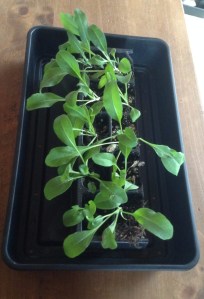 I don’t know if you have ever tried, but buying woad plants is quite difficult. Seeds are quite easy to come by, but I don’t have fantastic conditions for seeds and seedlings. One of the reasons I am starting a dye garden is that I can’t cope with vegetables.
 I’m quite excited.
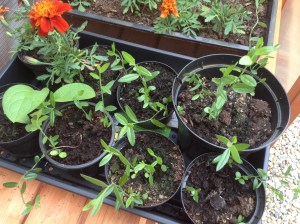 “Have nothing in your home that you do not know to be beautiful or believe to be useful” must know a thing or two.
 The Rainbow Angel